Convert litres per cycle into annual kilolitres and a cost scenario
Convert litres per cycle to annual kilolitres before applying an AUD-per-kilolitre rate. Keep fixed charges and programme differences visible.
Updated:

Start with the label's cycle and unit
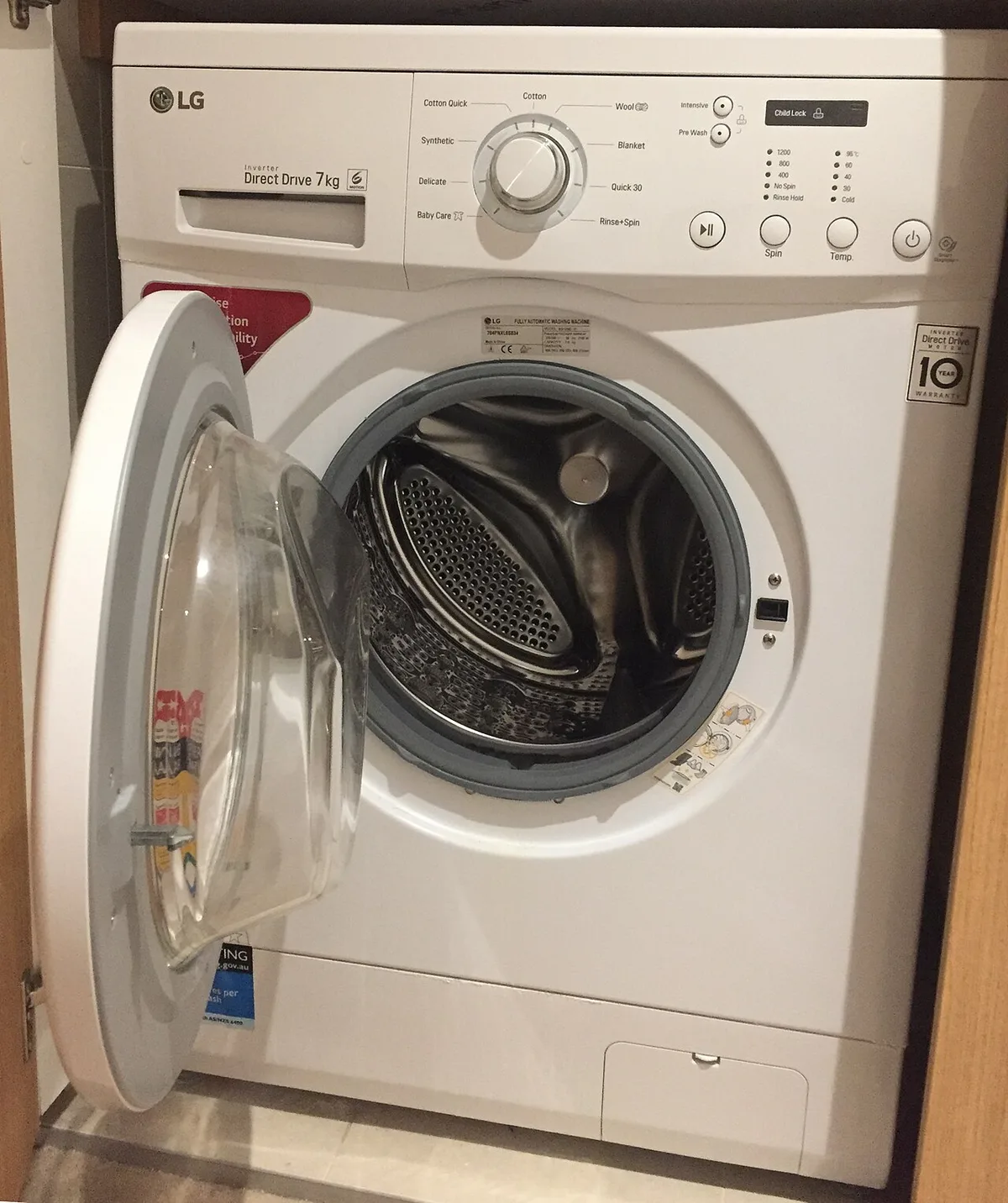
WELS provides litres-per-wash information for washing machines and dishwashers, together with capacity and tested-cycle details. To create an annual volume scenario, retain the cycle associated with the input and state how often that condition is assumed. A photograph of a washer selector shows why the distinction matters: the presence of several programmes does not prove that each uses the same amount of water. This guide's numerical example is deliberately fictional and is not assigned to the pictured machine.
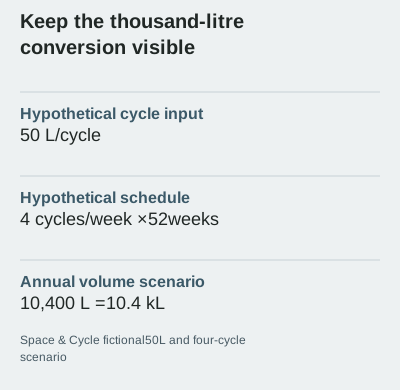
Convert a weekly routine into an annual volume
Assume 50 L per cycle, four cycles per week and 52 weeks. Multiplying 50 by 4 by 52 gives 10, 400 L. Divide by 1000 to express that volume as 10.4 kL. Keeping the conversion visible prevents a common unit mistake: multiplying litres directly by a rate quoted per kilolitre. The selected 52 weeks is a scenario convention, not a guarantee about the number of cycles a household will run. If the routine changes during the year, a single repeated weekly input may need to be replaced by separate periods.
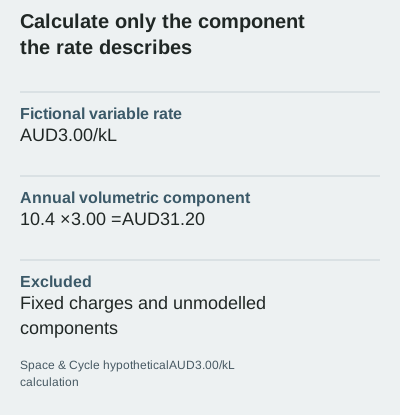
Apply a tariff only to the volume it describes
At a fictional volumetric rate ofAUD3.00 per kL, 10.4 kL givesAUD31.20. This rate is not a current local quote or an Australian average. Replace it with an applicable rate when using the tool for a personal scenario. If a bill includes fixed charges, tiers or other components, the simple multiplication does not model them automatically. Label the result as a volumetric component rather than displaying it as the complete water bill for the household or appliance.
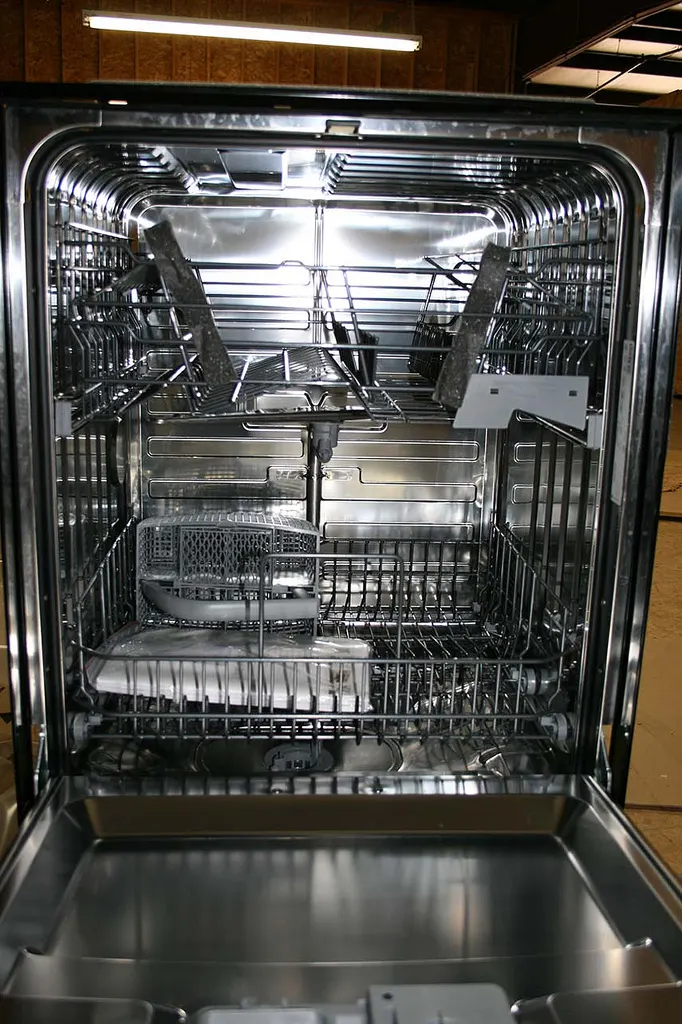
Do not assume a rack photograph proves a cycle result
The empty dishwasher interior shows rack arrangement but no verified water measurement. Its shape may be relevant to loading needs, yet it cannot establish the fictional 50 L input or any Australian rating. Use the exact product's documented information for a real calculation. If a different programme is selected, obtain an appropriate input or state the uncertainty. Do not assume that fewer visible dishes or a smaller-looking load produces a proportional reduction in water use without supporting evidence.
Keep an unknown rate different from a zero rate
The Siemens indicator photograph is not a water tariff or a WELS label. It reinforces a broader point: a symbol or familiar term is not a numerical input. When the relevant rate or cycle consumption is missing, leave the field blank until it can be established. Entering zero merely to complete the form produces a misleading low result. A genuinely chosen zero-rate scenario should be described as such, with the reason recorded separately from the appliance's resource consumption.
Use the calculation as a record of assumptions
Save litres per cycle, programme, cycle count, weeks, rate and source dates beside the result. The cycle-water tool shows the kilolitre conversion and resulting AUD component, making it easier to check a thousand-fold error. It does not estimate unrecorded programme behaviour or determine a supplier's billing rules. If comparing candidates, keep the schedule and tariff consistent while checking that the consumption inputs are comparable. A transparent scenario can then be revised when evidence changes instead of becoming an unsupported promise about annual savings.